Jamuna River Crossing Piling Methodology and Guide Frame
The integrated engineering solution provided the client with a complete installation methodology for the East-West Interconnector Project's challenging piling operations.

.jpg)
.jpg)
.jpg)
.jpg)
.jpg)
.jpg)
.jpg)
.jpg)
.jpg)
.jpg)
.jpg)
No items found.
The integrated engineering solution provided the client with a complete installation methodology for the East-West Interconnector Project's challenging piling operations.
The Jamuna River in Bangladesh is one of the widest and most dynamic river systems in the world. During peak flood season, the river can expand to nearly 20 km in width, creating a significant barrier between the eastern and western regions of the country. The East-West Interconnector Project was initiated to establish a critical electrical transmission link across the river.
The highly erodible sandy riverbanks present severe geotechnical challenges, with annual bank erosion rates reaching up to 400 m. To ensure long-term stability of the transmission towers, deep caisson foundations up to 12.2 m in diameter were required, supported by a combination of steel tube piles and reinforced concrete bored piles.
A key challenge was the installation of 44 steel tube piles, each measuring 2.5 m in diameter, weighing approximately 323 tonnes, and reaching lengths of up to 90 m. The piling operation also involved a 218-tonne hammer generating significant lateral loading during driving. Installation tolerances required pile plumbness to be maintained within 2 degrees in any direction, despite the substantial pile lengths, weights, and environmental conditions.
The magnitude of the loads, combined with the precision required, created a high-risk installation environment where pile misalignment could result in costly rework, project delays, or safety incidents. A robust and adaptable piling guidance system was therefore required to accommodate varying pile geometries and installation conditions while maintaining precise control throughout the operation.
In addition to pile driving, the project team faced significant lifting and handling challenges associated with tipping the piles from horizontal to vertical, safely lifting them, and operating within the lifting limitations of the available derrick barge. A complete lifting methodology, including custom lifting tools and tipping equipment, was required to facilitate safe and efficient installation.
Ratio Structural Engineering developed a comprehensive suite of temporary works and lifting solutions to address the project's unique challenges.
To ensure sufficient rigidity and reliability under extreme loading conditions, six full-scale engineering models were developed and evaluated. Finite element analysis was performed on critical connections, while detailed 3D CAD modelling was used to verify constructability and prevent mechanical conflicts throughout the operating range of the equipment.
Working closely with the site team, RSE maintained continuous communication throughout the design process, providing progressive design updates and detailed 3D visualizations to ensure all equipment could be fabricated and operated efficiently in the field.
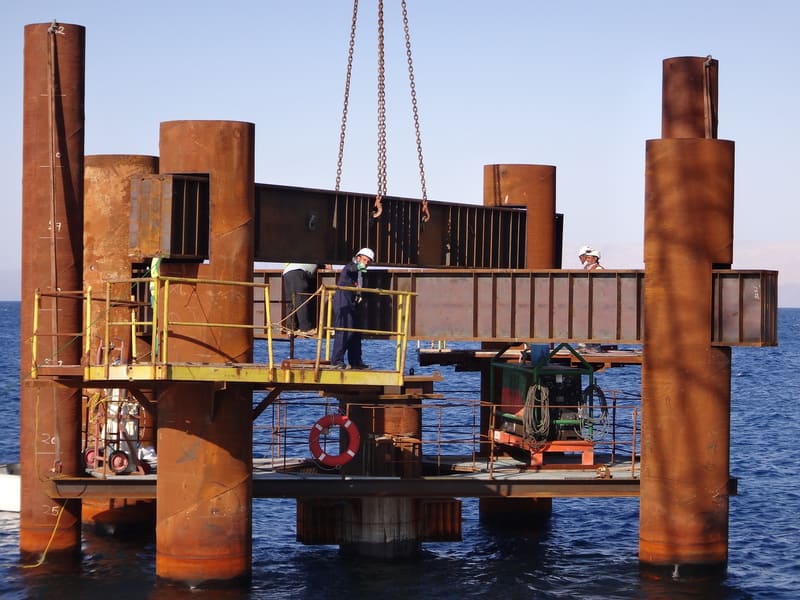
The centerpiece of the solution was a universal piling template mounted on a barge. The template incorporated hydraulic push-pull systems in both lateral directions, allowing operators to precisely position and align piles during installation. Innovative claw-style guide arms enabled lateral insertion of piles into the template, eliminating the need for top-down placement and overcoming crane boom clearance limitations. Adjustable roller assemblies provided flexibility to accommodate varying pile diameters while maintaining alignment control.
The piling template was designed to support pile self-weights of up to 234 tonnes while accommodating hammer loads of up to 250 tonnes.
To address the lifting and upending requirements, RSE also developed a custom L-shaped lifting tool capable of safely lifting and rotating piles weighing up to 200 tonnes. The extended bearing plate of the tool provided rotational stability during tipping operations, eliminating the need for additional support equipment.
A cantilevered pile-tipping frame was additionally designed for installation on the side of the barge. This innovative arrangement allowed piles to be rotated to a fully vertical position while extending approximately 7 m below deck level, further overcoming the vertical clearance limitations imposed by the crane boom and vessel geometry.
The integrated engineering solution provided the client with a complete installation methodology for the East-West Interconnector Project's challenging piling operations.
The lifting tool, and cantilevered tipping frame were successfully fabricated and deployed, enabling safe and controlled lifting and tipping of the large-diameter steel tube piles. The solution allowed the project team to utilize the available crane barge without requiring specialized replacement equipment, significantly improving constructability and project efficiency.
By providing a repeatable and adaptable installation methodology, the engineered solution enabled the contractor to overcome the key challenges associated with constructing transmission infrastructure across one of Bangladesh's most morphologically active rivers. The system reduced installation risk while maintaining the high levels of precision required for deep foundations located within a dynamic river environment.
By combining rigorous engineering analysis, innovative temporary works design, and close collaboration with the construction team, Ratio Structural Engineering delivered a practical and reliable solution for one of Bangladesh's most challenging transmission infrastructure projects. The successful implementation of these tools helped advance the construction of a critical transmission link connecting communities across the Jamuna River while maintaining high standards of safety, precision, and constructability.
Our team is dedicated to crafting spaces that reflect your unique style and needs—one thoughtful step at a time.

.JPG)